Wednesday, May 10, 2017

Overdue Thoughts On The Passing Of Tom Curley

Tom Curley passed away Friday, and I haven’t had much to say about it, until today.


As someone who makes his living with words – both written and spoken – I found myself uncharacteristically speechless at the passing of a man who did so much to shape both my life and my career.
It wasn’t like we didn’t see it coming. Tom had been in failing health for years, as the crippling effects of Chronic Obstructive Pulmonary Disease slowly extinguished the competitive fire that had burned so bright for so long. Last fall, we made plans to have dinner together the night before the annual Milk Bowl at his pride-and-joy race track, Vermont’s Thunder Road International Speedbowl. But Tom was under the weather than evening, and was forced to cancel.
“We’ll catch up next time,” he promised. But I think we both knew that might not be true.
Tom was singularly the most complicated man I have ever known. His childhood was filled with turmoil and upheaval, and as an adult, he was more comfortable with conflict than most. He was a feisty Irishman, a “my way or the highway” kind of guy who could be your biggest supporter and greatest tormentor, all in the same day.
And when it came to promoting stock car races, he was the greatest of all time.
Curley had an uncanny ability to see 10 years down the road, properly positioning his tracks and series for what was to come. I only saw him get conned once, when the Detroit automakers convinced him (and NASCAR) that V8 engines were on their way out, and that V6 power would be the wave of the future.
He was among the first to rail against the skyrocketing cost of competition, and absolutely the first to do something about it. He took control of the engines, implementing a low cost crate-engine program, despite violent opposition from the engine builders who had lined their pockets for decades at his racer’s expense. He mandated spec shock absorbers, then ensured compliance by periodically requiring competitors to unbolt their shocks after qualifying and swap them with a fellow racer. He implemented track tires that were often harder than ideal, ensuring that deep-pocketed racers could not simply spend their way to Victory Lane.
Curley implemented a “ladder system” at his local tracks, allowing entry-level drivers to test their skill and resolve in a dirt-cheap, four cylinder race car, without mortgaging their home to do so. Those who experienced success graduated to the second tier – the Flying Tigers class at Thunder Road – where they spent a little more money and went a little bit faster. The ACT Late Models were the headline class; the “thunder and lightning” division where the top drivers showcased their skills.
Over the years, lots of drivers climbed Curley’s ladder, all the way to the top. Nick Sweet, Mike “Beetle” Bailey, Jason Corliss and a number of others became Late Model winners -- even graduating to the traveling American Canadian Tour – after beginning their careers in Curley’s Street Stock class. Sweet won the ACT Tour championship in 2016, and few moments made Tom happier, or more proud.
Curley’s pit meetings were the stuff of legend. He had definite opinions on the way drivers should conduct themselves on the race track, and he had no qualms about expressing those opinions, often at top volume.
Hundreds of times over the last three decades, I heard him preach his motorsports gospel.  
"If a guy has the balls to run the high groove, get alongside you and pinch you down in the turn, you owe him the lane,” he said. “Either concede the position, or be a jackass and wreck both of you. He earned that spot, give it to him!”
Tom was also a stickler for “taking what the day gives you.”

"If you’re having a shitty day, take your 15th place finish, bring your car home intact and come back next week,” he’d say. “Don't screw with the guy who’s having a good day. Let him have his day, just like he’ll let you have yours when it’s your turn.”
Tom was also a big fan of props, often bringing toy race cars to the track as part of an animated demonstration of what did (and did not) qualify as acceptable on-track behavior. More than once, he demolished the cars with a hammer for effect, captivating his audience and delivering his message loud and clear.
Once, at a time when ACT’s core group of officials oversaw three weekly race tracks and a traveling tour each week, Tom would elect to repeat the previous night’s pit meeting; something the traveling officials corps jokingly referred to as “a rerun.”
“Tom,” I said on one particular late-night drive back to Vermont, “you need new material. I’ve seen the same damned driver’s meeting, four nights in a row.”
On the rare occasion where a pre-race sermon failed to have its desired effect, Curley took a more hands-on approach. He was known to red-flag a race that produced multiple crashes in the opening laps, stopping the cars on the front stretch, marching down through the grandstands, pulling the drivers out of their cars and reading them the riot act in front of the entire house. Invariably, he received a standing ovation on his way back to the official’s tower, before enjoying a caution-free event, the rest of the way.
One on especially egregious night at Thunder Road, the Flying Tiger class compounded a lengthy rain delay by throwing off three caution flags in the opening two laps. Tom parked `em on the frontstretch and stormed trackside, delivering a patented, arm-waving T-Bone tirade for the ages, punctuated by a crack of his umbrella across the race leader’s windshield.
He re-entered the tower wearing an impish grin, prompting me to ask simply, “What happened?”
“Goddamnit,” he replied, holding his demolished umbrella. “This was my Norwich Alumni umbrella. I really liked this one…”
Curley was an innovator, once adding a pink flag to the standard mix of green, white, yellow and checkered.
“This is the Pig Flag,” he announced to an incredulous group of drivers. “If you want to be a jerk and hog both lanes, we will show you this flag. Do it again and we’ll show it to you again. Do it a third time and you’ll be parked for the night, because you’re a lousy racer.”
The “Pig Flag” is still in use at Tom’s race tracks, and no one has ever gotten it more than twice.
There were no names in Tom’s pit area, just car numbers. He was as likely to penalize the point leader as any backmarker, and one year, he gave the most popular driver in the history of Thunder Road, Dave Dion, the heave-ho after his crew ran onto the race track to confront a driver who had triggered a wreck that turned their car upside down.
“I need to behave myself,” said one driver known for his temper. “If Tom will throw Dave Dion out, he’ll sure as shit send me packing.”
Curley also had a knack for painting the “big picture,” convincing a group of tough, take-no-quarter racers to look out for each other on the race track, while also doing what’s right for the fans. Every Opening Day at Thunder Road, Tom would deliver a variation on the same speech.
“Ken and I don’t own this place,” he’d say. “We just pay the mortgage. Those people up there (pointing to the grandstands) own this place. Without them, we’re all out of business. They spend their hard-earned money to come and watch you race, and you owe them a good, respectable, competitive show.”
During the height of the GM National Stock Car Series in Canada, Tom and I traveled to Toronto every few weeks, where I would voice-over the TV broadcasts that aired north of the border on TSN. It was an eight hour drive each way, just to do a 90-minute voiceover, turn around and drive home again. 
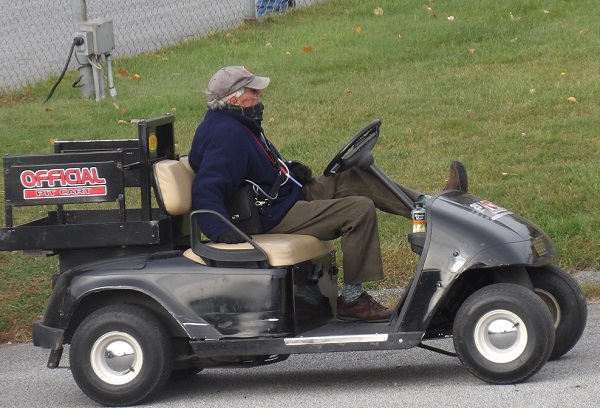
We made nearly a dozen of those trips, creating a slew of unplanned adventures and new “Tom Curley Stories.”
One night, TC and I were heading back to Vermont after a midweek voiceover, driving a Chevy Lumina Pace Car that had been provided by GM of Canada. The car was pretty trick, with some extra horsepower-producing doohickeys under the hood, a multicolored graphics package and side exhaust pipes that ran the length of the vehicle.
As anyone who knew Tom will attest, he loved wringing every last drop speed out of whatever he was driving, and this Pace Car was no exception. Unfortunately, after a few months of high-speed T-Bone abuse, the car had begun to show clear signs of fatigue. Halfway home, the passenger-side exhaust pipe came loose from its bracket and began dragging across the asphalt in a shower of sparks. Pulling over the examine the situation, we quickly determined that some “guerilla engineering” was required, if we were to make it home before dawn.
Tom and I removed our leather belts, knotted them together and wrapped them around the dislodged exhaust, running the other end through the open passenger-side window for me to hold. That may have been the longest ride of my life.
A few weeks later -- during another top-speed Toronto return – we drove up on a State Police roadblock at the entrance to what was then called “The Indian Reservation” in upstate New York. The trooper in charge informed us that the resident Akwesasne Tribe was up in arms over the latest in a decades-long series of tax disputes with the State of New York, and had constructed a large bonfire in the middle of the highway to express their displeasure.
“I wouldn’t go in there,” he warned. “If you get in trouble, we can’t come in after you.”
“Are you saying we can’t keep going,” asked Tom, knowing that doubling back would add at least an hour to our already too-late arrival time at home.
“No, but if you do, you’re on your own.”
Tom gunned the throttle and drove on, saying, “I guess we won’t have to worry about speeding tickets for the next few miles.” Not far down the road, we did indeed encounter a roaring bonfire in the center of the two-lane highway, with a few dozen locals huddled around for warmth. Tom matted the accelerator and blasted past – two wheels on the asphalt and two on the shoulder – showering the Native American “protestors” with gravel as they dove for cover in an adjoining ditch.
Tom was infamous for running past "E" on the gas gauge before stopping to fill up. I don’t know if he saw it as a test of manhood, or an opportunity to thumb his nose at the universe and its conventions. Either way, his penchant for “running on fumes” often resulted in him being stranded by the side of the road -- at all hours of the day and night -- out of gas.

One night, we were driving back from Toronto at 1 AM, doing 85 mph in a 45-mph zone. As usual, the "low fuel" light had been burning for at least a half hour, and as we approached one of the last gas stations we would see for a while, I said, "Tom, if you run us out of gas again in the middle of the night, you are going to push this car, while I steer."

"What do you mean," he said. "I can't push this car, I have asthma!"

"You have asthma," I replied, "but I have brains enough not to drive past another goddamn gas station at 1 o'clock in the morning!"

He chuckled under his breath, and pulled into the gas station. I think that is the only argument I ever won with Tom Curley.
Not all of my memories of Curley are happy ones. Like anyone who worked with him for any length of time, I felt his wrath on a number of occasions. He fired me twice during our 30 years together; once from my part-time post as a PR rep/college student, for failing to collect admission fees from the crowd at a Saturday night concert during New England 300 weekend at Catamount Stadium. It didn’t matter than I had never been told to do so. In Tom’s mind, I should have known.
I have always suspected that my firing had more to do with not wanting to keep me on the payroll during a long, cold, PR-starved Vermont winter; a suspicion that was bolstered when he happily hired me back the following spring.
But hey, I can’t prove a thing.
My second firing came prior to what would have been my 31st season on the public-address microphone at Thunder Road, and in truth, it was less a firing than a mutual parting of the ways. Two years earlier, I had accepted a position hosting the afternoon drive program on SiriusXM Satellite Radio’s NASCAR Channel. It was a great career move for me – not to mention a substantial increase in pay – but for Tom, it was a difficult decision to accept. In his mind, you were either with him or against him; all-in or all-out. After nearly three decades, the announcer who had always been waiting at the pit gate when it opened at 2 p.m. was now rolling in at 7:15, missing the first heat race of the night.
It bothered him, and to be completely honest, it bothered me, too. I felt like I was short-changing Thunder Road and its fans, something I had never wanted to do. I was caught between a rock and a hard place, forced to either give less than 100% for the first time in my life, or resign the position I had dreamed of since I was a little boy.
Tom solved the problem for both of us, sending me a polite-but-firm note the following spring, saying he had decided to “move in a different direction.” It broke my heart, but I understood his rationale.
Thunder Road was his top priority, and he needed people around him who made it their top priority, as well.
There was also a softer, gentler side to Tom that not everyone got to see.
In the mid-1990s, ACT was hired by owner Michael Liberty to operate Maine’s legendary Oxford Plains Speedway for a couple of seasons. It was a lot of work, with Thunder Road, Oxford, New York's Airborne Raceway and the traveling American Canadian Tour all under the ACT umbrella. A number of us traveled the entire circuit, racing 4-5 nights a week and sleeping little.
I personally considered Liberty to be a $100 haircut on a $5 head; an untrustworthy opportunist who used people to pad his bank account before kicking them unceremoniously to the curb. He proved me right at the end of the 1995 campaign, throwing ACT out on its collective ear and refusing to pay a substantial amount of money he allegedly owed. I was at the Radisson Hotel in Burlington, Vermont, preparing for ACT’s annual post-season Banquet of Champions, when my phone rang.
“Can you come down to Tom’s room? We need to have a meeting.”
Once assembled, we were told that Liberty had defaulted on his financial obligations, essentially leaving ACT bankrupt. The point fund would be paid – with some delay – but the series was shutting down, effective immediately. It was crushing blow for a group of people who had poured their hearts and souls into the series for many years. None of us knew where our next paycheck was coming from, but Tom demanded that we dry our tears and proceed as planned that evening.
“These people deserve their night,” he said. “They busted their butts all season long, and they deserve a celebration tonight, not a wake. We’re going to go out there and do our jobs, and only at the end will I tell everyone what has happened.”
Emceeing that banquet was one of the toughest things I have ever done; pasting a smile on my face and talking about what a great season it had been. But it was absolutely the right thing to do, and we did it because Tom wanted it that way.
T-Bone could be a tough guy to work for. There were days when I wanted to take him by the throat and shake him. But there were other times – the vast majority of the time, really – where I and dozens of others would have walked through fire for the man, if he had asked us to.
Last month, Curley and longtime partner Ken Squier sold their beloved Thunder Road to former racer Cris Michaud and local real estate developer Pat Malone, ensuring that “The Nation’s Site of Excitement” will survive and thrive for decades to come. Just days later, Thomas Michael “T-Bone” Curley was gone.
I like to think those two events were connected, in some way.
I like to think that Tom hung around just long enough to ensure that race fans in Central Vermont got what they deserved, one last time.
Have a good ride, Tom.
And Rest In Peace.

Monday, May 08, 2017

Junior Wins At Talladega!

It’s always a good day when Junior wins at Talladega.

Sunday’s GEICO 500 was no exception, even though the “Junior” in question was not exactly the one most fans had in mind.

Ricky Stenhouse, Jr., carried Roush Fenway Racing back to Victory Lane Sunday for the first time since June of 2014, starting on the pole and prevailing on a green-white-checked flag finish to claim his first Monster Energy NASCAR Cup Series win in 158 career starts.

Stenhouse’s upset victory puts his name at the top of a lengthy list of darkhorse victors at the 2.66-mile Alabama tri-oval, joining inaugural winner Richard Brickhouse, Dick Brooks, Lennie Pond, Ron Bouchard, Bobby Hillin, Jr. and Phil Parsons. Racing just 260 miles from his childhood home in Olive Branch, Mississippi, Stenhouse received a warm – if not quite Earnhardt-esque -- reception from the packed Talladega grandstand as he celebrated with team members, sponsors and girlfriend Danica Patrick in Victory Lane.

“This is for all the guys at the shop,” said Stenhouse. “Every race, we’re getting better and better.  We knew Talladega was a good track for us. It’s been good in the past and I’m glad we parked it for my buddy, (the late) Bryan Clauson. 

“This Fifth Third Bank Ford was so fast today. We qualified on the pole and got the win. It’s cool to have Jack Roush back in Victory Lane. This is cool. (It’s) the closest race track to my hometown and the fans were out here this weekend.”

Stenhouse’s win was the culmination of an early season competitive resurgence for Roush Fenway Racing, an organization that has had little to celebrate in recent seasons. The team contracted from three cars to two this season, allowing veteran Greg Biffle to seek his fortune elsewhere. Equally important were a series of management changes that revitalized RFR’s approach to winning races. Lifelong Roush man Robbie Reiser was reassigned from his post as General Manager; part of a long-overdue shift to newer, younger, more engineering-based minds.  

The results have been impressive, to say the least.

Stenhouse’s win was his fourth Top-10 finish in the last five weeks; following a 10th at Martinsville, a ninth at Bristol and a fourth-place showing two weeks ago at Richmond. Teammate Trevor Bayne also contended for the win Sunday, before being eliminated in a 15-car backstretch melee with less than 20 laps to go. Bayne has recorded seven Top-15 finishes in 10 starts this season, and if the post-season playoffs began today, both Roush Fenway Racing drivers would receive tickets to the dance.

There is still a bit more work to do before RFR returns to the ranks of championship favorites, but Sunday’s GEICO 500 was proof positive that progress is being made.

"There was no panic,” stressed Jack Roush Sunday, beaming from beneath his trademark fedora in a raucous Talladega Victory Lane. “I've been a racer for nearly 60 years – 30 of them in NASCAR – and I've been in holes before.

“I've climbed out of every one of them.”

While never doubting his ability to rebound, Roush admitted that Sunday’s win “comes with some relief.”

“It doesn’t get any sweeter than this,” said a happy Stenhouse Sunday. “It’s awesome to finally finish it off. I look at our first 150 (races) and I can only hope that the next 150 are going to be kind of like Joey Logano’s. He’s had 300 races. The first 150 weren’t great, the next 150 were. Hopefully this is the start of that.

“Pulling into Victory Lane and seeing Jack and Danica standing there together, it was super special. They’re the same height,” he laughed. “She supports me through anything I need to do, whether it’s spending more time at the shop (or the) need to…spend a little bit more time with the guys at the shop. She’s been so supportive and knows how hard that I’ve worked, and to have her there was really awesome.

“Every race, we’re getting better and better,” he added. “My confidence has been really high all year. We know what race tracks we need to work on. I feel confident in the guys back at the shop, Brian (Pattie) and everyone. There are not many teams that pay attention to the details like the No. 17 team does.”


Tuesday, April 25, 2017

COMMENTARY: Dale Junior Calls It a Career

It’s official. 

The 2017 season will be Dale Earnhardt, Jr.’s last a full-time Monster Energy NASCAR Cup Series driver.

The third-generation driver met with team owner Rick Hendrick to inform him of his decision on March 29 of this year, and the team confirmed just moments ago that after 18 seasons and more than 600 career MENCS starts, Earnhardt will step away at the end of the 2017 campaign. Earnhardt has driven for HMS since 2008, collecting nine of his 26 victories with the organization.

One year ago, concussion symptoms forced Earnhardt from the cockpit of his No. 88 Chevrolet for the second time in his career. NASCAR’s 14-time Most Popular Driver missed the final 18 races of the season, prompting widespread speculation that he would never return to competition.

“You want it to be on your terms,” said Earnhardt during the lengthy recuperation that followed. “You want to be able to say, ‘Alright, I’ve had enough. I’m done.’ If you get hurt and are forced to quit, that’d be incredibly emotional.”
Earnhardt refused to be carried from the battlefield on his shield last season; vanquished by a foe hidden deep inside his brain. After months of healing and therapy, he returned to competition in February at Daytona International Speedway, climbing back behind the wheel of his familiar, silver-and-blue Chevrolet and running up-front until a mid-race crash spoiled his bid for Victory Lane.
He returned to the sport on his own terms. And now, he will leave it the same way; walking away -- of his own accord -- while ranking as one of the most competitive and popular drivers of his era, or any other.

It is a fitting exit for a man who has given so such to the sport that has framed his existence from the beginning.

His childhood included a superstar father who was habitually absent while fulfilling the obligations of a NASCAR champion, often at the expense of his own children. Many of the photographs of Earnhardt, Jr.’s youth feature him in the background of various Victory Lane ceremonies, home from military school just long enough to stand on the sidelines as his legendary father celebrates with team members, sponsors and a stepmother who -- to this day – did little to include him in her husband’s happiness.

After such a rocky start, the relationship between Earnhardt Sr. and Jr. took many years to repair. And just when it had finally begun to bear fruit, “The Intimidator” was killed on our sport’s grandest stage, leaving his youngest son to shoulder an impossibly heavy burden of expectation that he had neither asked for, nor welcomed.

Despite a pair of championships in what is now the NASCAR Xfinity Series, Earnhardt, Jr. has heard his share of criticism over the years.

“He’s not his daddy.”

“He’s not aggressive.”

“He’s not a seven-time champion.”

Admittedly, Earnhardt, Jr. has never won a MENCS championship in his 18-year career. Currently ranked 24th in the championship standings, he is unlikely to do so this season, either. But at this point, who really cares?

When fans look back on Earnhardt’s career, they will certainly remember the wins and losses. But more importantly, they will remember the easygoing style that made him so beloved across NASCAR Nation. Last season, 25% of all NASCAR souvenir sales included Earnhardt’s name, number and/or sponsor. His fan base crosses international, economic and intellectual borders, and NASCAR will be hard-pressed to replace him in that regard.

Equally difficult to replace will be the honesty, humility and sense of humor that have made Earnhardt a Media Center favorite since his earliest days in the sport. No one puts more thought into an answer than Junior, and while he has never been a standard-bearer or spokesman for his fellow drivers, his opinion carries a weight and importance that very few competitors have ever equalled.

Despite his multi-million dollar bank account, Earnhardt remains a man of the people. Like his father before him, Junior resonates with the working man; the guys who build tree houses in their backyards and fill the woods with old junk cars.
Make no mistake about it, however. Dale Earnhardt, Jr. is not his father. Never has been, never will be.
They share a name and an avocation, but that’s where the similarities end. Dale Earnhardt, Jr. is no Intimidator. The “bull in a china shop” style that made his father a cult hero has never been part of Earnhardt the Younger’s racing DNA. With Junior in your rear-view mirror, you are more likely to be outfoxed that outmuscled; a fact that never sat entirely well with the small segment of his fan base that cheered him because of his genetics, rather than his personality.
Earnhardt has always been his own man. A man that we will miss seeing behind the wheel of a 200-mph NASCAR race car.
But let’s be honest. Since his injury at the midpoint of last season, most observers understood that Earnhardt’s driving career would likely be measured in months, rather than years. In many ways, he has raced on borrowed time since then, willfully dodging the high-speed impact that could end his career at any moment. If he is able to do so for another 28 weeks, the third-generation driver will walk away with life and limb intact, able to devote his attention to his JR Motorsports Xfinity Series organization, and – more importantly – to life outside of racing.
Recently married to the former Amy Reimann, Earnhardt spoke in January of last year about the impact marriage has had on his life.
"It's a very cool thing,” he said, “and I am so frustrated with myself that I didn't do it sooner. I didn't know things could be this good. It’s a great feeling to be able to depend on someone and (have) them be accountable and be there."

"Having her in my life has made my life an amazing thing.”

Now, there will be time for Dale and Amy to grow and explore as a couple, perhaps even starting that family he has spoken so glowingly of in the past.


And as for us, we will be just fine, you and I. NASCAR will survive without Dale Earnhardt, Jr., in the starting lineup, just as it did 15 years ago with his legendary father.

Tuesday, March 28, 2017

Atlanta Waves Off Resurfacing Plan For Another Year

After an in-depth review and consultation with NASCAR, Goodyear, race teams and drivers, Atlanta Motor Speedway has elected to postpone its plan to resurface the 20-year-old racing surface until at least after its 2018 NASCAR weekend.

Last paved in 1997, the abrasive AMS surface is known for producing slick and challenging racing conditions, with some of the fastest tire fall-off of any track on the circuit. A number of  drivers voiced concern when plans to resurface the track were announced in January of this year, urging track ownership to delay the project.

AMS will continue a meticulous maintenance program in an effort to maintain the surface and prevent further deterioration. Additionally, patch work on the current asphalt will be completed, where necessary. Track officials will reevaluate its condition following the 2018 triple-header NASCAR weekend and determine whether to undertake a complete resurfacing, with new asphalt to be laid over the current surface.

“We appreciate all of the input we have received from key individuals in the NASCAR industry, as well as our customers,” said Ed Clark, Atlanta Motor Speedway president. “The overwhelming majority have urged us to hold off on paving so that we can enjoy at least one more weekend of high-speed slipping and sliding in 2018 before the new surface is installed.”

Since it was paved in 1997, the track has hosted 32 Monster Energy NASCAR Cup Series races, 20 NASCAR XFINITY Series races, 16 NASCAR Camping World Truck Series races, eight ARCA Racing Series races, four IndyCar Series races and countless U.S. Legends and Bandolero car races on its quarter-mile “Thunder Ring.”

Monday, March 27, 2017

COMMENTARY: Rulings Leave Drivers On Uncertain Ground

Less than two weeks ago, NASCAR Executive Vice President Steve O’Donnell appeared to lay down the law in the aftermath of a post-race skirmish between Kyle Busch and Joey Logano at Las Vegas Motor Speedway.

O’Donnell, the sport’s chief spokesman in times of strife and upheaval, warning that the sanctioning body would not tolerate any on-track retaliation and would react strongly to instances of drivers using their car as weapons.

Just days later, the sanctioning body failed to act when Austin Dillon did exactly that, squeezing Cole Custer’s car into the outside wall under caution at Phoenix Raceway after Custer inadvertently wrecked Dillon late in Saturday’s NASCAR Xfinity Series race.

NASCAR parked Dillon for the remainder of the event – a token penalty, since his car was already too damaged to continue – then declined to assess any further sanctions or penalties.
“Don’t do it again,” was the official response. “Or else.”
That mixed message leaves drivers and fans to wonder exactly what is – and isn’t – allowed these days, especially in the aftermath of a similar no-call for the pit road imbroglio between Busch, Logano and their respective crews a week earlier.  
"Every situation is different" said O’Donnell last week, insisting that drivers know where the line lies between acceptable behavior and actionable offense.

Unfortunately, the drivers say they don’t.

Dillon wrecked Custer under caution
“I don't know that it gives us an answer of what we can or can't do,” said Ryan Newman, Dillon’s teammate at Richard Childress Racing. “You have to do what's best, and what's best is not always the same in everybody's eyes. Being aggressive -- whether it's with your race car or your hands -- doesn't always lead to the answer. But it sometimes gets your point across, and sometimes that's what's needed.”

Dale Earnhardt, Jr., also weighed-in on NASCAR’s response, saying, “It's not about trying to teach (Dillon) a lesson. It's really (about) what we are trying to tell everyone else, all the other drivers.
"I know NASCAR takes these guys into the haulers,” he added. “They have conversations with them and tell them what they expect in the future, But no one else is privy to that conversation. That is not sending the message to anyone, because we don't know what the message is.”
NASCAR has fined drivers for fighting in the past. They have also declined to do so.

NASCAR has fined drivers for intentionally damaging competitors’ cars -- under green or under caution – in the past. They have also declined to do so.

O'Donnell: "No two incidents are alike."
It’s all a matter of degree. And in the words of William Shakespeare, “There’s the rub.”
As is often the case, NASCAR finds itself in an untenable position. The sanctioning body is expected to rule consistently on a series of incidents – both on and off the race track – that vary wildly in both severity and circumstance. Fists are different than fenders, and high-speed takeouts are different than harmless bouts of post-race fender rubbing.

No two incidents are alike, and no written rule can cover the myriad ways that drivers express displeasure with each other.

“I don't particularly envy NASCAR's position,” said former Monster Energy NASCAR Cup Series champion Brad Keselowski last week. "There is something to be said for our responsibility in this sport to be role models, and I'm as guilty as anyone else of not doing the best job of that, sometimes.

"We're all trying to ask ourselves… 'What's too much emotion?' I'm not sure anyone has really got a great answer to that.”

Clearly, NASCAR cannot allow its garage area to degenerate into a 700-horsepower version of the OK Corral, with drivers and team members taking matters into their own hands with impunity. They also cannot afford to take the emotion out of the sport, however, turning speedways into Safe Zones where conflict and disagreement are strictly forbidden.

Somewhere in the middle lies a line between acceptable and unacceptable. Unfortunately, that line isn’t always straight.

"I got punched in the face and I still race hard," said Keselowski, harkening back to a 2014 dustup with Jeff Gordon that left him battered, bruised and unpenalized. "Everybody has got their own way of looking at it."
“There is a very fine line" said Dillon with a smile. "I have morals of my own. I try to stick by a moral code that my family brought me up by. Everybody makes mistakes and NASCAR did a good job being a father-like figure to me in this situation. They expected more out of me… (and) I need to handle the situation differently.
“I really don't know what to do,” he smiled. “I haven't gotten my UFC license yet.”

Monday, March 20, 2017

COMMENTARY: Just Four Races In, Busch Faces Critical Juncture

With just four races complete in the 2017 Monster Energy NASCAR Cup Series season, Kyle Busch finds himself at a competitive crossroads.

Despite a season-best third-place finish Sunday at Phoenix Raceway, the 2015 series champion finds himself a disappointing 13th in the championship standings, embroiled in the sort of controversy that has sidetracked him more than once in the past.

Two weeks ago, Busch and Joey Logano tangled while battling for fourth place on the final lap at Las Vegas Motor Speedway. Busch spun in the final turn, finishing 22nd before confronting Logano after the race, throwing a punch and triggering a wild melee that left him with a bloody cut on his forehead.

Busch vowed revenge immediately after the scuffle, saying of Logano, “He’s going to get it.” 

NASCAR declined to sanction either driver, with Executive Vice President Steve O’Donnell saying, “Kyle Busch and Joey Logano are two of the most passionate and competitive drivers in the sport. Both competitors are very clear on our expectations going forward and we will be meeting with them in person prior to practice on Friday in Phoenix.”

Little is known about Friday’s 15-minute meeting. O’Donnell made it clear that the sanctioning body will not look kindly on any further incidents between the two, saying, “If it escalates beyond to something intentional on the race track, we were very clear that we'll react."
Busch and Logano tangled in Las Vegas
Logano, meanwhile, struck a conciliatory tone, saying, “I tried to explain that I made a mistake underneath him. He asked for some data (and) I was able to show him that. It was pretty clear in my opinion what happened, so that's that. I hope he's able to see that and know that I was sincere about it. Time will tell."
Busch chose a different path, taking a page from the playbook of Seattle Seahawk running back Marshawn Lynch, who once filled an entire press conference by answering every question with a terse, “I’m only here so I don’t get fined.”
“Everything’s great,” said a tight-lipped Busch after emerging from the NASCAR hauler Friday. “Looking forward to getting back in my race car and having a fantastic weekend here in Phoenix.”
The Joe Gibbs Racing driver repeated his "everything's great" five times -- in response to five different questions – before being ushered away by his PR reps, raising the art of sarcasm to a whole new level.
Busch then dominated Sunday’s race in Phoenix, leading a race-high 114 laps and leading the final stage by a comfortable margin until a caution flag with six laps to go – ironically triggered when Logano blew a tire and crashed – led to a pit-road bump with brother Kurt Busch that cost him what appeared to be a sure trip to Victory Lane.

"Everything's great..."
“Everything’s great,” said a clearly unhappy Busch after rallying to finish third. “We got a Top-5 (finish), and that’s what we set out to do today. We should be pumped about that, and how good this Skittles Camry ran.”

He did offer one fleeting moment of candor, saying, “It seems like every finish that’s destined for us seems to end in a worse finish.”

Busch’s unhappiness is understandable. No one climbs happily out of a wrecked race car. No one speaks calmly after being pulled from the depths of an eight-man, pit road Battle Royal. No one celebrates a third-place finish, snatched from the jaws of victory.

Busch’s No. 18 team – and Joe Gibbs Racing as a whole – is off to an uncharacteristically slow start to the 2017 campaign. Their 22nd-place showing in Las Vegas followed a 38th in the season-opening Daytona 500 and a 16th at Atlanta. Prior to Sunday, the four car JGR stable of Busch, Denny Hamlin, Matt Kenseth and rookie Daniel Suarez had managed just one Top-5 finish in 12 combined starts.

By his own admission, Kyle Busch is a lousy loser. Anything less than a checkered flag on race day leaves him crabby and on-edge.

It is simultaneously his worst trait, and his best.

The same “refuse to lose” mentality that has made him a champion has also produced a series of distractions that compromised his championship efforts in the past. Now, Busch must overcome the urge to let his slow start – and his issues with Logano – become a distraction. He must display the maturity and focus that have characterized his last two seasons by refusing to be lured off track, both literally and figuratively.

This week’s race at Auto Club Speedway offers Busch a tailor-made opportunity to refocus and reload. He recorded four consecutive podium finishes at the Fontana oval from 2011 to 2014, winning in both 2013 and 2014.

The next few weeks will prove whether the “kinder, gentler” Busch can keep his eye on the prize, instead of being swept onto the same emotional rocks that have sunk his ship so many times in the past.


Tuesday, March 14, 2017

Harvick To Host New Show On SiriusXM

SiriusXM announced today that 2014 Monster Energy NASCAR Series Champion Kevin Harvick, driver of the No. 4 Ford Fusion for Stewart-Haas Racing and one of the sport’s most popular drivers, will host a new exclusive show on SiriusXM NASCAR Radio, available to listeners nationwide on satellite radios and the SiriusXM app.

Happy Hours will debut on March 28 and air every Tuesday from 7:00 to 9:00 pm ET, featuring Harvick’s distinctive perspective on the sport and life outside the track.  Harvick and co-host Matt Yocum will take calls from listeners and give NASCAR fans a unique view on the driver’s life and interests when he is away from the race car.  In late May, the show will begin airing every other week.

“I’m excited to partner up with SiriusXM NASCAR Radio and give the fans an inside look at what it’s like to be a NASCAR driver in today’s age,” said Kevin Harvick. “It will be fun to give the listeners my opinion on things that are happening within our sport.”

“Kevin is one of the most exciting drivers on the track, and an extremely fun-loving person off the track,” said Steve Cohen, SiriusXM’s SVP of Sports Programming.  “That combination of competitiveness and personality is perfect for SiriusXM.  Kevin and Matt will create a show that is enlightening, entertaining and unlike anything else on the airwaves.”

Harvick has 35 career NASCAR Cup Series victories, including wins in such crown-jewel events as the Daytona 500 at Daytona (Fla.) International Speedway, the Brickyard 400 at Indianapolis Motor Speedway and the Southern 500 at Darlington (S.C.) Raceway. In addition to his impressive performance in NASCAR’s Cup series, Harvick is a two-time Xfinity Series championship with 46 Xfinity Series wins and 14 Truck Series victories. 

SiriusXM NASCAR Radio (Channel 90) airs 24 hours a day, 365 days a year and delivers in-depth racing coverage and inside access to NASCAR news, including live broadcasts of every Monster Energy NASCAR Cup Series™, NASCAR XFINITY Series™ and NASCAR Camping World Truck Series™ event.

Fans can call in to the channel to share their opinions and be a part of the daily discussion, and can also access SiriusXM NASCAR Radio programming when they want it on SiriusXM On Demand.  The channel’s roster of expert hosts features current and former drivers, crew chiefs, crew members and a host of NASCAR insiders.  For more info on SiriusXM NASCAR Radio’s programming and personalities go to www.SiriusXM.com/NASCAR.

Childers On Manufacturer Change: "We Expected To Do Well"

Kevin Harvick is off to a solid start to the 2017 Monster Energy NASCAR Cup Series season, and with a stop scheduled at his favorite track – Phoenix International Raceway – this weekend, crew chief Rodney Childers says he is not surprised by his organization’s fast start to the 2017 campaign, or its rapid adaptation to an offseason change to Ford power.

“I think we all expected to do well,” said Childers, whose driver has gone to Victory Lane in six of the last nine MENCS races at Phoenix. “We worked really hard over the winter and all of our preparation has been really good, but the biggest thing is just keeping that going over time. Our group has done a good job of that the last three years, but we just have to keep it up.  Hopefully, we can keep doing that as the year progresses.”

Coming off a hard-luck, 38th-place finish at Las Vegas Motor Speedway last weekend that saw driver Kevin Harvick cut a tire and slam the wall in the early going, Childers said he is happy to be returning to Phoenix International Raceway, where the team tested earlier this season and has had tremendous success in the past.

“We’ve had a good setup there that last three years, but the test didn’t start out the way we wanted,” he said. “We struggled the first day and about half the second day, then we got going really good at the end of the second day.  We learned a lot out there and look forward to going back and hopefully having another shot at the victory.”

Childers said he and Harvick focus on PIR’s tricky third and fourth turns, adding, “that’s where we seem to excel... getting through three and four and rolling through the center of the corner. That’s what we struggled with out there at the test, just trying to keep the back of the car under him (while having) the front end of the car turn. I think we got it a lot better toward the end of the test and, hopefully, we can be even better when we go back.”

While Harvick has had success in accumulating bonus points under NASCAR’s new stage-based race format, Childers insisted, “We don’t worry about that side of it.  We just try to be as fast as we can and lead as many laps as we can. That has paid off for us in the past. Hopefully, we can keep that up as the year goes on.”

Childers also spoke about the difference between last year’s Chevrolets and this season’s Fords, saying, “It definitely feels like the Ford body has more front bias balance than what we were used to. That’s just something you’ve got to figure out with a few tests and racing it a little bit. It’s just a change. It’s not something that’s going to hurt one way or another, you just have to adapt to it like we adapt to changing tires each week. Overall, it’s been good and we really haven’t had any issues with it.”